
I’m in Europe for the next two weeks, traveling. Fear not — I’ve still lined up great content for you while I’m away. Today Dr. Sarah Duvall steps in to discuss a topic that matters to anyone who loves lifting heavy: squats, and how to make them feel better.
Her new resource, created with fellow coaches Kellie Hart and Meghan Callaway—the Glutes, Core, and Pelvic Floor Workout System—is on sale now through July 2. It’s excellent, and I think you should check it out.
Are you engaging the right muscles when you squat? A few months ago Tony and I met at a café to trade notes. After more than 30 years combined helping people, we both agree: strength is your friend—for rehab, for life, and for aging. In short, you need to lift to fix things. It can get tricky when the wrong muscles do the work, so you don’t overload the wrong parts. For example, squats that load mostly the quads and low back instead of balancing with the glutes and abdominals, or deadlifts felt in the back rather than in the glutes or hamstrings. You’ll be trying to get stronger, but you’re overworking a subset of muscles rather than the intended targets. That’s why it helps to know which muscles you want to work and where you should feel it. Educated lifting.
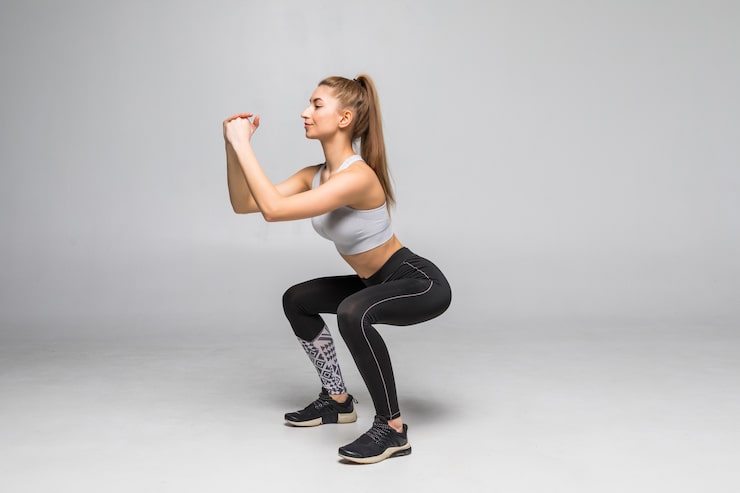
Let’s break down the squat a bit. There are many varieties, from goblet to back to front squats. Pick a variation that feels right for you, but here are a few tips to squat in a way that targets your glutes and abs, especially if you primarily feel squats in your quads and low back. We’ll start from the ground up across four key areas.
First, keep your toes grounded. Lifting the toes became a popular cue, but it can shift weight back toward the knees and away from the hips. While you want to sit back into your hips, lifting your toes can trigger a chain that increases hip flexor activation and reduces ab engagement. Try this: lift your toes and notice how much your abs engage. Now plant your foot with a short stance (big toe down, arch engaged, weight evenly across the ball and heel) and see if this grounds your abs more. Foot placement sets the tone for the rest of the body. To train the sit-back pattern without lifting your toes, practice squatting to a box or chair.
Second, sit into your glutes. You want your glutes to lengthen as you squat; it’s not just a knee bend. If you fold in half to sit back, or if you have long femurs or a narrow stance and still lean forward, you may need to adjust your rockbacks. If you arch your back to sit into the squat, your low back can feel tight afterward. To fix folding, try holding onto something—like suspension straps—while you squat to practice sitting back into the glutes.
Third, keep a neutral spine. How you start sets the tone. If you arch your back to begin, your brain thinks, “this is a back exercise.” If you engage the glutes from the start, your brain thinks, “this is a glute exercise.” It’s easier to do it right from the beginning than to play catch-up. Can you notice the difference between starting with glute engagement versus starting with a low-back arch?
Fourth, head alignment. Do a quick test: look up at the ceiling while you squat and see if you feel the urge to overarch your back. Now tuck your chin to your chest and squat. Notice how your posture changes. The head guides the body, so adjusting where you look can dramatically affect the squat. If someone struggles to engage the abs, a slight look downward can help; if they struggle to sit into the glutes, a slight look upward can help. The key takeaway is to know where you should feel the exercise and make sure that’s happening. When you squat, you should feel your glutes and quads, as well as your abs and lower back. A balanced squat engages everything, allowing you to work harder and stay stronger without getting hurt because the effort is shared.
Want to learn more about where you should feel an exercise and which muscles should be working? You’re in luck: Glutes, Core, and Pelvic Floor Workout System. Three expert coaches—Sarah Duvall, Kellie Hart, and Meghan Callaway—have teamed up to create a thorough 12-week program to help you reach your fitness goals. It’s designed for everyone—women and men, powerlifters and CrossFitters alike—and can be done at home or in a gym with minimal equipment. I’ve tried a few of the workouts and movements, and they’ve already highlighted weaknesses I’m working on. This program can help you become a better coach and a stronger lifter.
The price is heavily discounted—$200 off—for two days only (June 28–29). It increases by $100 on June 30–July 1, and then goes to full price on July 2. You don’t have much time to take advantage, so consider it now.
