
I remember the first time I saw Eminem perform. It was spring break in 1999, and I was in my apartment between classes, watching a bit of TRL on MTV. A few friends were off somewhere else, probably soaking up sun and debauchery in Cancun. MTV was in Cancun too, hoping to catch a glimpse of my friends—and Britney—as I watched. “Hi, my name is, what? My name is, who? My name is, chka-chka Slim Shady.” I was mid-bite, thinking, what on earth is this? Eminem really exists now? Trying to impregnate the Spice Girls? “Pfft, whatever,” I figured. “He won’t last.”
Ten number-one albums, more than 45 million records sold, and one pretty solid movie—8 Mile—earned him a lot. So you could say I was a bit of an idiot for doubting him. Eminem did pretty well for himself.
And while I could sit here and reminisce about other pop-culture missteps I’ve made, I’ll spare you the trip down memory lane. Some things just stick: chicks will always dig stone-washed jeans; Robert Downey Jr. will never be Iron Man; ABC’s What About Brian? (2006) would supposedly be the next Grey’s Anatomy or Lost. Let’s not indulge too much in my misjudgments.
Adele? She’s okay. I guess.
Speaking candidly, my “misses” extend to the coaching side of things as well. I can think of a few ideas I used to believe or say that, in hindsight, were pretty dumb. Here are two examples.
1. TELLING PEOPLE TO ARCH…HARD
Like many folks who lift heavy things, I read—and still read—anything I can by Dave Tate, Jim Wendler, and Louie Simmons. All three are strong guys and have produced some of the best training advice for getting strong in recent decades. It’s hard to argue with these guys; they’ve contributed a lot to the field, and many of our PRs come from their articles and resources.
That said, a few years ago I had to audit my coaching of the squat. After learning about the Postural Restoration Institute (PRI) and hearing other strong lifters like Chad Wesley Smith discuss it, I started wondering whether cues to “arch, hard!” and to “sit back” were right for most athletes I trained.
Most of my clients were not geared powerlifters, and none wore squat suits that require a big arch and a strong sit-back. There are still strong lifters who advocate the hard arch, and that’s fine—that’s their approach. But what works for geared lifters rarely translates well to non-geared lifters.
If I tried to balance “I want to be brutally strong AND not wreck my spine on this next rep,” I’d opt for less arching. The ribs and diaphragm point upward while the hips and pelvic floor point downward, which isn’t a stable setup. It creates a lot of shear on the spine and tends to force the lifter to start the movement by sitting back rather than down, so the chest often collapses forward, and the default cue becomes “arch, arch, arch, chest up, chest up.” That just feeds instability.
A better approach for non-geared lifters is to adopt what’s called the canister position. Credit where it’s due: Dr. Evan Osar popularized the phrase. Think of your pelvis as one ring and your rib cage as several rings. You want all those rings stacked, which helps you move into a more stable, joint-friendly position.
Some people worry this means a posterior pelvic tilt or flattening the lumbar spine. It doesn’t. In the canister setup, the hips stay behind the bar (still important), but you reduce the aggressive arch. Telling someone to posteriorly tilt toward spine neutral is different from telling them to flatten the spine. From there, you squat down rather than back.
2. KNEES FORWARD INSTEAD OF KNEES OUT
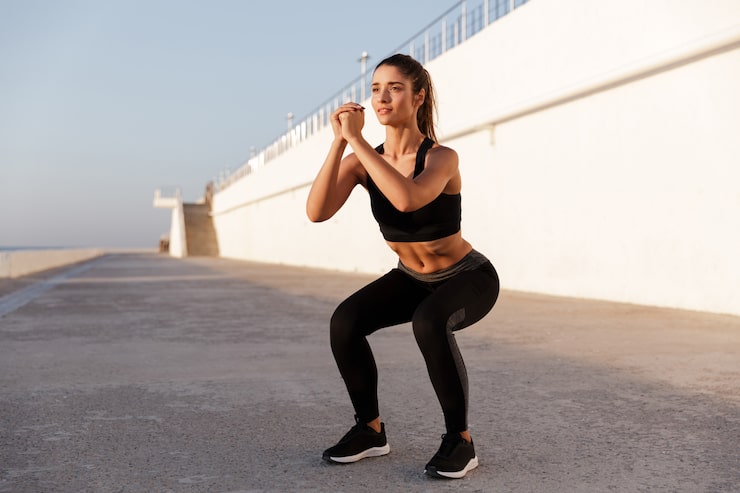
The cue to push your knees out? I’ve stepped away from it over the past year. For many lifters, the squat is more about sitting down than sitting back. I want the movement to look like a squat, which means the tibia translates forward over the toes (without the heels lifting) and you get a balance of knees moving forward and hips going back. Down is the goal.
My smart physical-therapy friend, Dr. Doug Kechijian of Resilient Performance Physical Therapy in NYC, put it this way on a recent tweet: it’s okay, even better, for the knees to travel forward. Cues that force someone to fight the knees outward often remove the need to remind them to push the knees out; they’ll do it automatically. I’m all for using less coaching to clean up technique—the last thing your clients need is a barrage of cues: “chest up, knees out, eyes forward, chin tucked, what’s the square root of 47?”
Play with the idea of the knees breaking forward first, then sitting down. Things often feel cleaner, more powerful, and the squat starts to feel more like a squat.
Addendum: none of this claims to be gospel. These are just cues and approaches that have worked for me with clients and athletes in recent months and years. You might think I’m batty, and that’s fine. I’ve been wrong before. Amazon.com? Such a stupid idea.
I hope you’ll consider these suggestions and try them for yourself. You might be surprised.
Anyone get the reference? Pete Rock & CL Smooth? Anyone? It lasted one season. One fucking season. Come on.
