
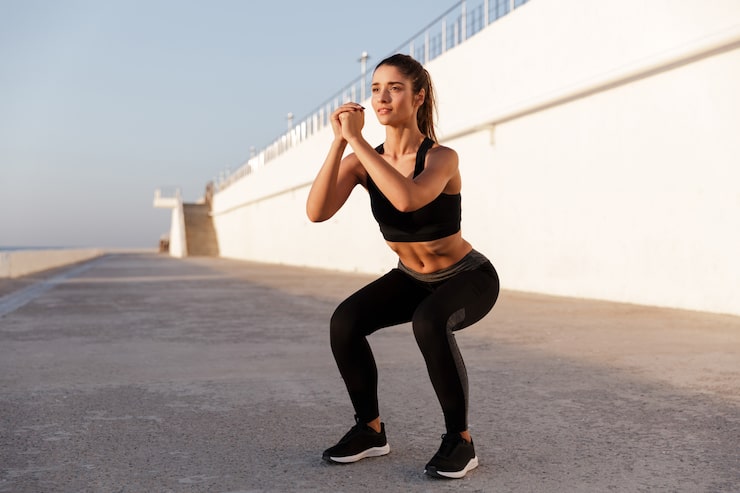
Squat Like a Girl
I’m truly honored that Tony named his firstborn Julian after me. I’m not here to talk about Baby Julian, though; I’m here because of Baby Julian—about why “squatting like a girl” can be different from squatting like a boy.
After five years in a female-only gym and seven years training many women (and being a woman myself), I’ve learned that tips for men don’t always translate to women because our bodies are different. That’s one reason new clients can struggle with squats or seem blank when asked to squat. Squats can be tricky, and most exercise science was developed for men by men. But a good squat helps women build overall strength and aid weight loss, which are common goals I hear.
Whether you want to use an Olympic barbell on your back or just get in and out of a chair, you’ll want to learn how to squat properly. Here are four key ways women can improve their squat:
1) Use Your Butt
Squatting is widely praised as a great exercise for building the glutes, but many women don’t engage them fully. That’s partly because we sit a lot and tend to overwork the front of the body while the back is underused. The glute muscles can “fall asleep,” a phenomenon some call “glute amnesia,” a term from back specialist Stuart McGill. If you don’t use your glutes in a squat, the brain-muscle connection weakens, making it harder to recruit the glutes when you squat.
To fix this, the common cue to “sit back” can become a balance challenge of gripping the ground with your toes, sticking the butt back, leaning forward, and not getting real benefit. Instead, tell yourself to lift your toes off the ground and press weight into the heels. This helps reinforce the brain-to-glute connection. This is what “sit back” aims for, but the body often takes the easiest path.
If this feels awkward or you wobble, you’re probably not doing it wrong—you just need more strength. Keep practicing, and you might start with a bench to build the hang of it.
2) Redefine the relationship Between Knees and Toes
The common cue is, “Don’t let your knees go past your toes.” The idea is to keep weight back in the heels and mid-foot, not up on the toes. But people are built differently. For example, if you have long thigh bones, it can be better to let the knees go past the toes. The focus should be on keeping your shoulders straight up and down as you squat.
So, instead of fixating on knee position, work on keeping your weight back, the barbell over the mid-foot, and your back upright.
3) And one more thing about your feet
You’ll often hear, “Squat with your toes facing forward,” but many women feel more comfortable with a slight turnout. The hips and leg bones are built to be a bit wider, so turning your feet out a little can reduce knee tension. Rather than forcing a forward-facing stance, aim to keep the knees above the toes, which often means turning the feet outward slightly. For some, a narrower stance or turning the toes inward can cause knee tension.
If you’re unsure how wide to point your toes, try this: stand barefoot with your heels together on a smooth surface, squeeze your glutes, then slide your feet apart until your heels are under your shoulders. This is usually a comfortable position for your body. Experiment and see what feels best.
4) Show Your Ankles Some Love
Tight calves can limit ankle mobility (dorsiflexion), which is crucial for squatting. This is common in women who wear heels or flip-flops and don’t stretch. Limited ankle movement can lead to compensations like flattening arches, knees caving in, or leaning too far forward.
A simple ankle-mobility test: place your toes four inches from a wall. Without lifting the heel, bend your knee to touch the wall. If you can, you’re good. If not, practice twice daily until you can reach the wall consistently.
Wrap-up
Most women want to lose weight, shape their glutes, and get stronger. The bottom line is simple: squat as much as you can, once you’ve mastered squatting “like a girl.”
Author bio
If you enjoyed this and want more, you can subscribe to my weekly tips on technique and strength for obstacle course racing. You can also follow me on Instagram. Megan Julian is a New York-based NASM-Certified Personal Trainer with certifications such as FMS Level 2, NASM-CES, and CFSC. She specializes in helping brides prepare for their big day, helping obstacle course racers improve their times, and working with clients of all ages to overcome injuries. In her spare time, she enjoys running in the woods, jumping over walls, and crawling under barbed wire — sometimes at events like the World Championship Obstacle Course Race in Canada.
