
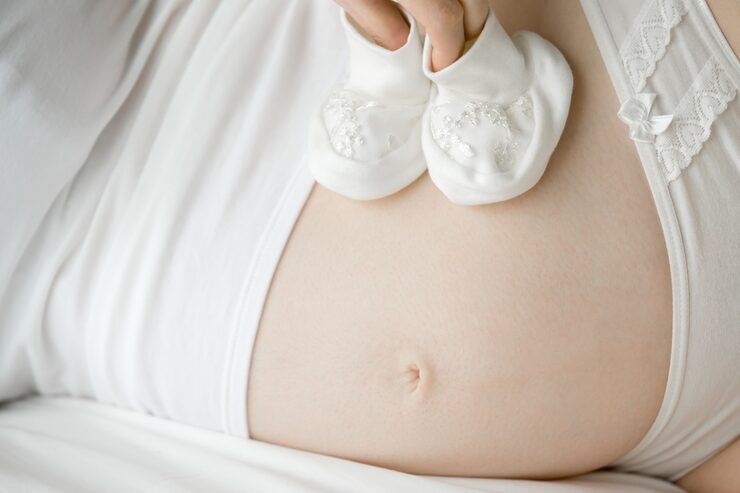
My son, Julian, was born January 31, 2017. Four days later Lisa and I headed to the gym. The workout wasn’t anything fancy—no burpees, no deadlifts, no squats. I don’t even think there was a barbell involved. If anything, that trip to the gym felt like a small step back toward normal life after the past few days had flipped our world upside down. After the shellacking we’d taken, a twenty-minute session sounded exactly what we needed. It was an oasis for us.
Lisa’s first postpartum workout wasn’t anything to brag about. I had her do some dead bugs, side planks, a few Pallof presses, bodyweight step-ups, and yes, there was a barbell involved too—she did some light biceps curls. To her credit, Lisa trained throughout her pregnancy. Not at her usual intensity, but she deadlifted, swung kettlebells, performed hip thrusts, and even used her growing tummy as a natural progression to chin-ups. At the same time, she listened to her body—if something felt off or wonky she stopped and we adjusted. I wholeheartedly believe that her dedication to strength training during pregnancy contributed to a smoother birth.
For more detail on my approach to training women through pregnancy, see my other article.
Fast forward several weeks: I posted a video on Instagram of Lisa hitting a bench-press personal record. During her maternity leave we took advantage of having more time to work out together, and I was proud of her for staying proactive. She listened to her doctor, she listened to her body, and she managed to regain some of her pre-baby strength fairly quickly, largely because she stayed consistent during pregnancy. I’d say “some,” because we made a point of not pushing the envelope with other movements such as deadlifts and squats.
Then a woman chimed in with concerns about postnatal recovery. “It takes a lot longer than 2-3 weeks to retrain the postnatal core! And wouldn’t she still be bleeding at this stage? That’s an open wound that needs time to heal,” she wrote, suggesting a women’s health physio or pelvic PT and asking what postnatal courses we’d done. I wanted to rage, but I held back. In her defense what she probably read on social media was a brag about a heavy bench press a few weeks postpartum. How could she know that in the weeks leading up to that Lisa had also been performing diaphragmatic and positional breathing drills, deadbugs, bird dogs, carries, hip-stability work, and many other exercises that don’t show up in a post as a bench press?
There’s a lot of noise about the “most boring exercise ever,” but I explained that Lisa had been cleared by her doctor, was taking things slow, using appropriate progressions, and had a smart coach writing her programs. The same woman also stated, “There’s nothing badass about being a victim to the social pressure to get your body back.” Given no one had mentioned social pressure at the time, I didn’t have much to say, though I could see where she was coming from. My wife has been lifting weights since she was 13—part of who she is—and we were enjoying an activity we loved together. She really loves benching, so why should I have to defend that? Still, I could see how her comment could be coming from real experiences, and I chose to consider it rather than dismiss it.
Don’t get me wrong: there was a lot of assuming on that woman’s part. Who were we to assume we’d taken every precaution? But I could see the point—the idea that women who train through pregnancy can be at more risk for postpartum issues. Many feel pressure to return to the gym as soon as they feel “okay.” That doesn’t mean you can’t exercise postpartum, but it does mean you should respect your body’s need to catch up.
I probably should have said that more clearly from the start when I posted Lisa’s bench video. What really hit home was her first comment: “What postnatal courses have you done?” Shit. None. I understood, to the best of my ability, the complexities of helping a woman train through pregnancy and postpartum. The first few months are about rebuilding the base—reconnecting the core with the pelvic floor and diaphragm. After that, a person’s capabilities depend more on their foundation than on any fixed timeline.
AS FAR AS THE BIG NO-NO’S TO AVOID IMMEDIATELY POSTPARTUM:
Plyometrics—burpees, jumping, stairs, running.
Anything close to max-effort loading.
Front abdominal exercises that bulge the abdominal wall or rely on the core to support a lot of bodyweight.
And yes, even Fight Club-style workouts are out of the question during this time.
I’m also aware that the postpartum phase isn’t limited to weeks or months. Some issues can surface years later, so it’s crucial to assess and program accordingly. But to go back to that first comment: “What postnatal courses have you taken?” I hadn’t taken any. It was time to fix that.
Pregnancy & Postpartum Corrective Exercise Specialist 2.0
Whenever I’m asked what course I’d recommend to other health/fitness professionals, my answer is Dr. Sarah Duvall’s PCES course. It’s the most valuable continuing education resource I’ve found in four years, and it’s had a huge impact on my coaching. Every pregnancy is different. Every postpartum journey is different. There are a lot of women out there, and you’ll undoubtedly need this knowledge.
Sarah just revamped the course to PCES 2.0—34 hours of content, with lectures, videos, and case studies. CEUs available. You can save $150 off the regular price through Wednesday, February 24, and registration closes March 5. Payment plans are available. This course teaches the right assessments and corrective strategies to address pelvic floor dysfunction, incontinence, rectus diastasis, and, what I love about Sarah’s approach, that strength training can—and should—be part of the process.
Remember: you’ve got until midnight on 2/24 to save, and access to the course closes on 3/5.
Says the guy who didn’t pass a cantaloupe through his vagina.
Which isn’t to say I disagree. I think there’s a lot of validity to her statements.
