
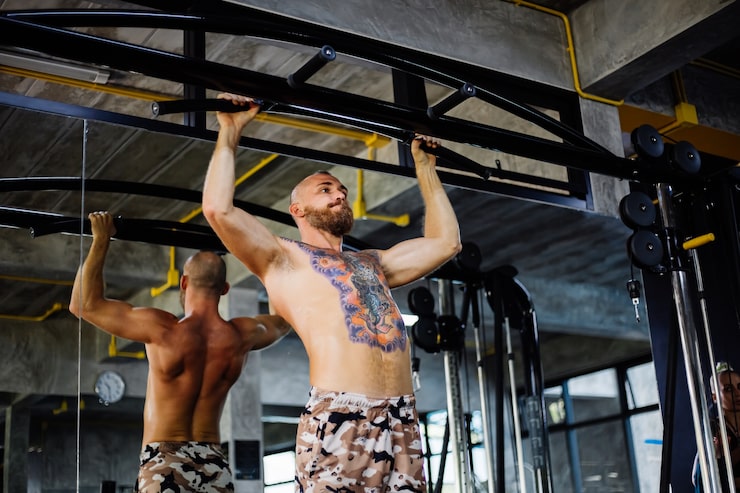
I’ve been thinking about some practical thoughts and programming tips for pull-ups. The plain truth: to improve at any activity you actually have to do it. Specificity matters. I’ve already outlined several ways to progress pull-ups on this site.
You’re not here for Macadamia Nut Cookie recipes, or the best uses of tape.
So today I’ll share a few of my go-to non-pull-up exercises that help build the pull-up. Let’s dive in.
A Quick Aside: I work with many clients who want to perform their first strict bodyweight pull-up. They’re often told to hammer two drills over and over: eccentric-only pull-ups and band-assisted pull-ups. That advice isn’t all bad, and I use it too, but it’s a bit short-sighted. It can miss a key point: training frequency.
If you want to conquer your first pull-up, you need to train it more often, and you need a broader training menu so you can train it more often. In every session I try to include something that nudges toward that goal. This includes hollow-position pull-ups, band-assisted or eccentric pull-ups, hanging leg raises (knees bent or straight), bent-arm hangs, many rows, and various pulldowns.
Here are a few more to consider:
1. Bear Stance Fallout — borrowed from Vernon Griffith. It’s a core-heavy drill that also teaches the pulling motion back to the start. Start with solid push-ups to build proficiency first; stronger push-ups tend to help everything else, including pull-ups.
2. Bottoms-Up Carry with Band — the connection between the pelvis and ribcage is huge. The pull-up is a full-body move, and this drill helps you feel that connection while building solid shoulders.
3. Rack Pull-Ups.
4. Leg-Assisted Pull-Ups — simple but useful for a confidence boost and adds a degree of specificity, since it’s a vertical pull but not a full pull-up yet.
That’s the idea. The main goal is to practice more often and expose yourself to a range of exercises that move you toward your first pull-up. I hope you can use them.
And by “it” I mean not just the pull-up itself, but using accessory movements to build strength and fix technique—just like we do for deadlifts and squats.
