
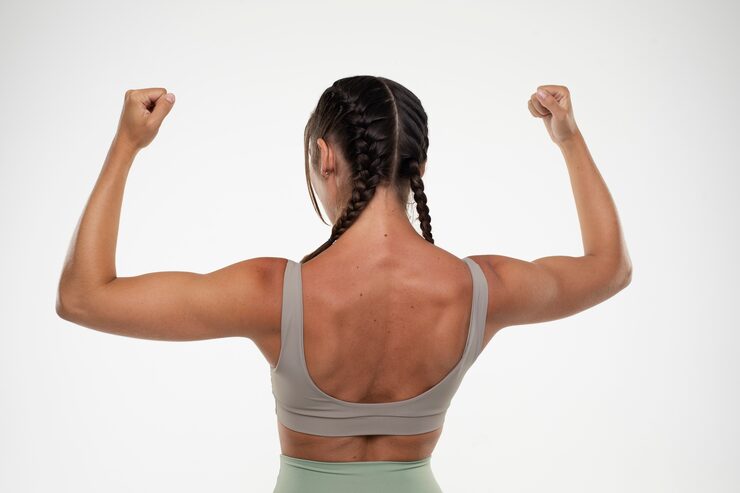
I train a lot of women. If I break down my client roster, it’s roughly a 50/49/1 percent split: women/men/Centaur1. I’m in a strength and conditioning bubble where most women I work with don’t blink at building muscle, and many actually want it. Today, a guest post by my friend Dean Somerset explains why most women can and should want the same thing. By the way, Dean and Dr. Mike Israetel released a great resource this week, The L2 Fitness Summit Vol 1, which dives into assessment and how to get clients results. It’s a strong program, and it’s on sale for a limited time.
WOMEN AND HYPERTROPHY: WHY SHOULD WOMEN GET JACKED?
The vast majority of my clients are female—about seven in ten at any given time. The reasons they train with me vary a lot: they might be dealing with a medical issue or injury, or they’re chasing a performance goal like running a faster marathon or deadlifting more than their body weight. In most of their aims, the idea of adding muscle sits somewhere between unimportant and undesirable.
Sometimes there’s a practical factor. If a client has invested heavily in a wardrobe and suddenly their lats look too prominent, it could mean alterations or buying new clothes. There are also social concerns, like a partner’s worry about becoming “too bulky.” It’s a common talking point, but a few pounds of muscle won’t turn a woman into a man. If anything, a bit more muscle can help a lot of goals in the gym.
Muscle looks better across most body fat levels, and it helps performance—whether you’re aiming to do more chin‑ups, deadlift heavier loads, or sprint faster. Muscle also supports higher calorie needs, which can make it easier to eat enough without changing body composition in a negative way. It can improve bone density, hormonal function, and sleep, and even help clothes fit better.
Science aside, will hypertrophy training make you bulkier? It can, but there are many factors at play. Muscle gain is a slow process, and a noticeable increase in body mass is often about 5%. For someone who weighs around 130 pounds, that’s roughly 6.5 pounds. In practice, elite competitors may take a long time to gain that much, requiring a dedicated routine with frequent workouts, precise nutrition, and consistent training. A reasonable pace for many women is about 3 pounds of actual muscle per year in a caloric surplus, which often means training targets of four to six hypertrophy sessions per week for a full year. It’s not impossible to gain more quickly, but that’s the typical rhythm.
A real-world example: Kait Cavers, who aims for figure competition, recently shared a before-and-after at the same weight. The difference was striking. She looked noticeably more muscular in the after photo, yet her waist and hips appeared smaller. The point isn’t that one look is better than another; it’s that you can look very different at the same body weight depending on muscle and fat composition.
If you’d rather not commit to that level of workload, you can still gain muscle more gradually by phasing hypertrophy into your year. You can cycle the calendar to emphasize different goals, or sprinkle hypertrophy work in rather than make it the entire focus. This flexible approach is a hallmark of how many coaches plan training. Ben Bruno, for example, works with Victoria’s Secret models in a way that emphasizes heavier resistance, hypertrophy work, and conditioning without making them look bulky.
ASIDE FROM GAINING MUSCLE, WHAT OTHER GOOD COULD TRAINING FOR HYPERTROPHY OFFER?
If you’re pursuing a specific goal—powerlifting, running, or weight loss—shifting into a hypertrophy phase for a while can refresh your mental approach and give your body a break from your usual routine. I’ve seen this in my own life. My wife spends most of the year cycling long hours as a road and track racer, with 15–20 hours a week on the bike during the season. In the off-season, she shifts to heavier weights for 6–8 weeks. The lighter relative loads and easier recovery make sense after months of cycling, and the gains in muscle help prepare her for heavier work later while keeping her balanced and fresh.
I’ve also worked with athletes recovering from injuries. For an ACL rehab, we focused on maintaining quad volume with lighter loading and moderate volume before progressing to heavier work as strength returned. The goal is to regain muscle mass and function in a safe, progressive way, so they can get back to activities they love.
Gaining muscle can be challenging, especially for someone already well into their training. But women shouldn’t fear hypertrophy; they should consider including it regularly or periodically to support their goals. Extra muscle is a boon for a wide range of objectives, even small daily tasks. And who knows—maybe lifting more would have helped Jill avoid that tumble, and she could have carried that water back home instead.
SPECIAL LIMITED TIME OFFER
Dean Somerset and Dr. Mike Israetel filmed 11 hours of content at the L2 Fitness Summit. Half of it focuses on assessments, the other half on getting people jacked and swole. It’s on sale for a limited time, with a notable discount, and it includes continuing education credits as part of certification requirements. If you’re seeking CEUs, this program offers value beyond the content.
If you’re ready to take the next step, the program is there to help you build strength, size, and performance in a structured way. The core message remains: training for hypertrophy can be a powerful and practical component of many training plans, especially for women who want to improve body composition, performance, and overall health.
